There is a particular elegance in preserving something that still has value. In commercial roofing, that philosophy is expressed through carefully specified Roof Coating Systems—restoration assemblies designed not to disguise an aging roof, but to work with an existing system whose underlying condition remains suitable for continued service. What appears from a distance as a clean, continuous finish is actually the final layer in a far more deliberate process of inspection, preparation, repair, detailing, and protection.
The distinction matters. A roof coating should never be mistaken for cosmetic paint brushed across weathered material in the hope that imperfections disappear beneath it. Commercial restoration is more exacting than that. The roof must first earn the right to be preserved. Its membrane or existing surface, drainage, flashing, penetrations, substrate, previous repairs, and potential moisture conditions all influence whether restoration is appropriate.
The beauty of a successful coating project lies almost entirely in what happens before the finished surface begins to shine.
“True restoration does not conceal the past. It understands what remains sound, corrects what does not, and gives the roof a more deliberate future.”
Restoration Begins with What Already Exists
Every successful restoration begins with restraint. Before discussing silicone, acrylic, polyurethane, reflectivity, or finish, the existing roof deserves a careful reading. Its surface carries a history: patches from previous service calls, seams that have weathered differently from the surrounding material, flashing around equipment curbs, penetrations added long after the original installation, and drainage patterns shaped by years of exposure.
A thoughtful evaluation looks beyond appearance. A faded or weathered surface may still belong to a roof that is a reasonable restoration candidate, while a roof that appears comparatively intact may require deeper investigation if there are indications of moisture or deterioration beneath the visible surface. *What can be seen is important, but it is not always the complete story.*
Drains and scuppers deserve particular attention because coating cannot transform inadequate water management into good drainage. Flashing and penetrations must be examined because a continuous roof field is only as dependable as the transitions that interrupt it. Where moisture within the assembly is suspected, appropriate investigation becomes essential before the restoration scope is finalized.
This is the moment when experienced Commercial Roof Restoration Services should feel less like product sales and more like building analysis. The objective is not to find a coating for every roof. It is to determine whether enough of the existing assembly remains suitable to make preservation a technically responsible choice.
If the substrate is unstable, deterioration is widespread, or significant underlying conditions cannot reasonably be corrected through restoration, coating should not be treated as a shortcut around replacement.
That principle gives restoration its credibility. Knowing when not to coat a roof is every bit as important as knowing how to coat one.
The Quiet Precision Behind a Coating System
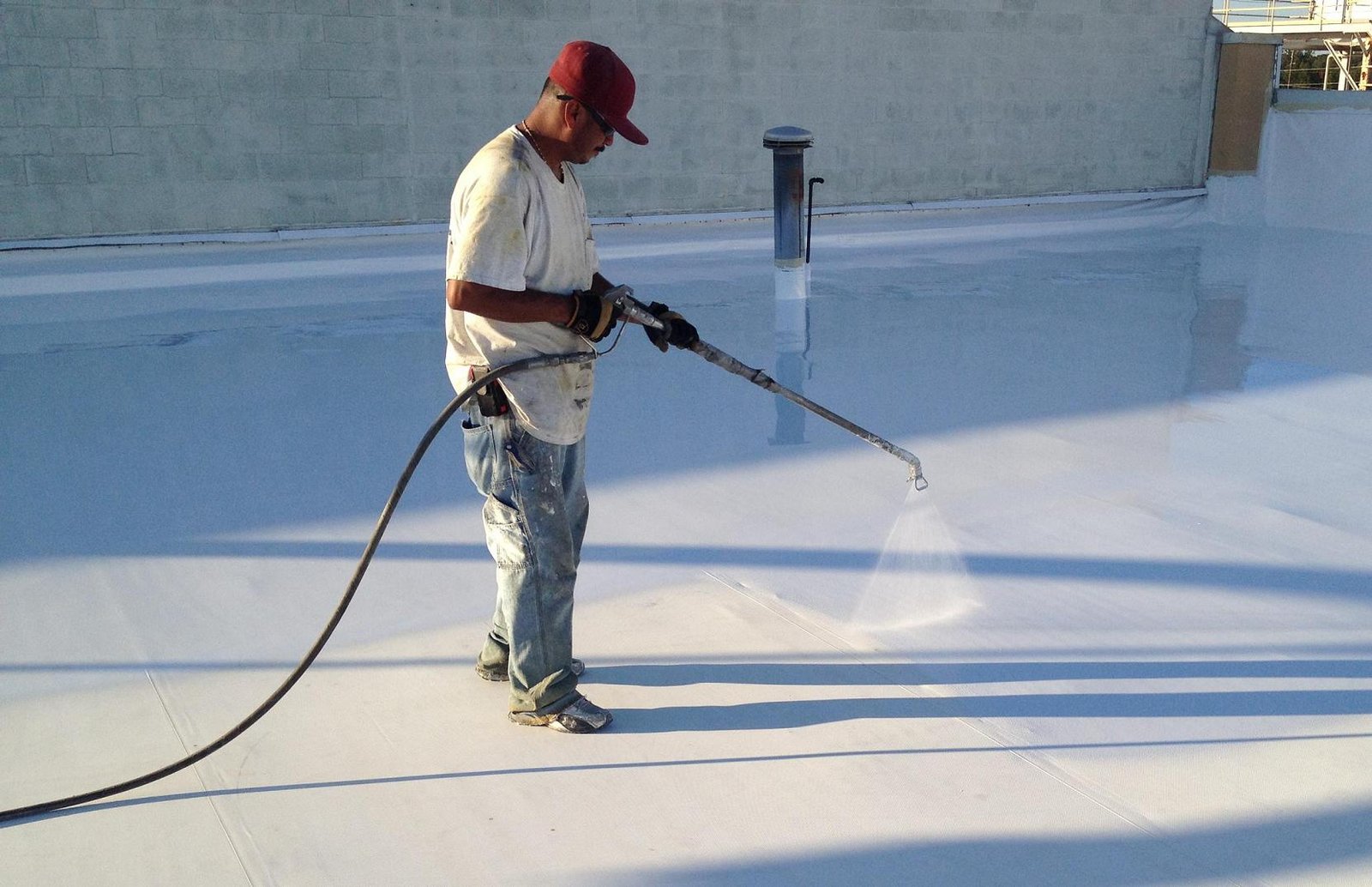
Once a roof has been determined to be an appropriate candidate, the transformation begins—not with the coating itself, but with preparation. Dirt, contaminants, loose materials, and other conditions that could interfere with the specified system must be addressed according to project and manufacturer requirements. Existing deficiencies are repaired. Seams, flashing, penetrations, curbs, and transitions receive the detailing required by the restoration specification.
There is something almost architectural about this stage. The broad roof field may cover thousands of square feet, yet the quality of the finished project can depend heavily on comparatively small areas: the circumference of a penetration, the termination at a wall, the edge of a drain, or the transition around a piece of mechanical equipment.
Precision becomes most visible where the roof stops being simple.
Primer may be required for certain substrates or coating systems. Reinforcement may form part of the specified treatment at seams or details. Application conditions must fall within the requirements of the selected product, and coating must be installed at the specified rate and thickness rather than merely applied until the surface appears visually complete.
“The finished coating may be what everyone notices, but preparation is where the quality of restoration is decided.”
Only then does the roof begin to assume its renewed appearance. The patchwork of weathering, repaired details, and aged surfaces gives way to a more unified finish. On reflective systems, the visual change can be particularly striking: a dark or inconsistent surface becomes lighter and more continuous, creating the crisp visual character often associated with restored commercial roofs.
Yet aesthetics are incidental. Beneath that seamless appearance should be something far more meaningful—a documented sequence of repairs, preparation, detailing, and application designed around the actual roof rather than around an abstract promise printed on a product label.
Choosing a Finish for the Roof You Actually Have
The coating itself brings another layer of sophistication because chemistry matters. Silicone, acrylic, and polyurethane systems each bring distinct characteristics, but reducing them to a simple hierarchy misses the point. *The finest material is not the one with the most impressive list of advantages; it is the one whose characteristics correspond to the conditions of the roof.*
Silicone coatings are frequently considered where resistance to water exposure and ultraviolet weathering is important within the project specification. Acrylic systems are widely associated with reflective commercial roof applications and have their own substrate, weather, drainage, and application requirements. Polyurethane coatings can offer mechanical and abrasion characteristics that may be valuable where toughness or rooftop activity influences the design.
Within each family, however, individual formulations differ. Approved substrates, primers, application rates, cure requirements, finished thickness, reflectance, and other performance properties should come from the technical documentation for the specific system being considered.
A refined restoration strategy does not ask, “Which coating is best?” It asks, “Which coating belongs on this roof, under these conditions, for the way this building is actually used?”
That shift—from product preference to building-specific specification—is what separates a coating application from a true restoration strategy.
Preservation Is a Long-Term Discipline
The first days after a roof coating project can be visually satisfying. The surface appears cleaner, more unified, almost architectural in its simplicity. Yet the true measure of restoration begins after that initial transformation, when the roof returns to the ordinary demands of commercial life—sun, rain, wind, maintenance traffic, mechanical servicing, debris, and the gradual passage of seasons.
A restored roof should therefore enter a maintenance program while its condition is still well documented. Project records, product information, photographs, repair locations, coating details, and inspection notes create a valuable baseline. Future evaluations can then compare current conditions with a known starting point rather than relying on memory or incomplete maintenance history.
Drainage remains one of the quiet disciplines behind that long-term care. Drains and scuppers should remain unobstructed, while areas where water movement appears to change deserve attention. A coating may provide a renewed protective surface, but it does not eliminate the fundamental requirement that a low-slope commercial roof manage water effectively.
The same is true of penetrations and rooftop equipment. HVAC technicians, electricians, communications contractors, and other trades may cross the roof long after the restoration crew has left. New equipment may be installed. Existing components may be replaced. Tools can be dropped, materials dragged, and new penetrations introduced into a surface that had once been carefully detailed.
Preservation, in other words, is not passive. It requires the building owner to recognize that the roof continues to change even when nothing appears to be happening.
“A restored roof should not disappear from the maintenance calendar simply because it has disappeared from the repair list.”
Regular professional inspections provide an opportunity to identify developing conditions while they remain understandable. Changes at flashing, penetrations, seams, repaired sections, drainage areas, and high-traffic locations can be documented and addressed according to the requirements of the installed system.
This is where the sophistication of restoration becomes clearer. The project is not merely about extending the usefulness of existing materials today. It is about creating a roof whose condition can be observed and managed more deliberately tomorrow.
When Restoration Becomes the More Refined Choice
Commercial construction has long been attracted to replacement because replacement feels definitive. Remove what has aged, install something new, and begin again. There are situations where that approach is unquestionably appropriate. A roof with widespread deterioration, unsuitable underlying conditions, significant moisture-related concerns, or an assembly that can no longer provide an appropriate foundation for restoration may require a more comprehensive intervention.
But replacement should not become an automatic response to age or weathering. When substantial portions of an existing roof remain suitable, when deficiencies can be corrected, when the substrate is compatible with the specified coating system, and when restoration requirements can be satisfied, preserving what still performs can be an intelligent alternative.
There is sophistication in knowing the difference between something that looks old and something that has ceased to be useful.
That is perhaps the most compelling idea behind modern roof coating systems. They invite property owners to look more closely before removing an existing assembly. They ask whether the roof can be repaired, prepared, detailed, and protected rather than simply discarded because its surface has weathered.
The most refined roofing decision is not automatically the newest roof. It is the decision that preserves what remains valuable, corrects what has failed, and replaces only when the evidence says preservation is no longer enough.
This philosophy does not make restoration universally preferable. Quite the opposite: it demands a more disciplined standard for deciding when restoration belongs. Moisture conditions must be understood. Substrate compatibility matters. Drainage cannot be ignored. Repairs must be completed correctly. The coating must be specified and applied as a complete system rather than treated as a decorative finish.
When those conditions align, however, the result can be remarkably elegant in its logic. An existing commercial roof is evaluated rather than dismissed. Serviceable materials remain in place. Deficiencies receive focused attention. A compatible protective system is installed. Documentation creates a new maintenance baseline.
And above the building, the once-weathered surface takes on a quieter character—continuous, renewed, and prepared for the next stage of its service.
True restoration has never been about making something old appear new. It is about understanding what deserves to remain and giving it the care required to continue.